Past Event
The route and site is step-free.
St. Clement’s was once a large psychiatric hospital on Bow Road. At its peak in the 1930s, it cared for around 750 patients. Over time, numbers declined, and in 2006 the hospital closed its doors. Patients were transferred to Mile End Hospital and other community-based services. The buildings were later redeveloped, and today the site is home to private residents. But an important question remains: what does this place still mean for former staff, service users and the current residents?
It is 20 years since St. Clement’s closed its doors. Despite the hospital’s importance in the East End, there is currently no public recognition of the staff and patients who lived and worked there. This absence feels like a loss—not only for the staff who dedicated their working lives to caring for the community, but also for the service users whose lives and experiences have left no visible trace.
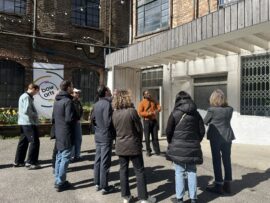
The walk will be led by ex-staff members from St. Clement’s who worked there across several decades. Dolly Sen – an artist, survivor and mental health and disability activist will create an art intervention as part of the walk.
This event is part of Backyard Biennial.
The project is led by Professor Paula Reavey on behalf of the Leverhulme funded Centre for the Sciences of Place and Memory at the University of Stirling. Anchored in Philosophy and housed in the Faculty of Arts and Humanities, the Centre draws on cognitive sciences, social sciences, and the arts to break new ground in the study of spatial thinking, disorientation, and remembering. It connects the sciences of space and memory with contemporary practical concerns about memory, cognition, emotion, and place.
Dolly Sen is an artist, survivor and mental health and disability activist will create an art intervention as part of the walk. Dolly is working class, Queer, interested in disability and the madness given to us by the world. She wants to disrupt systems that produce that programming called oppression, not through trojan horse viruses but with my little ponies on acid with a little sadness in their hearts.