Fri 28 Aug, 3-5pm
Clore Creative Studio
| Monday | Closed |
| Tuesday | 11am–6pm |
| Wednesday | 11am–6pm |
| Thursday | 11am–9pm |
| Friday | 11am–6pm |
| Saturday | 11am–6pm |
| Sunday | 11am–6pm |
Whitechapel Gallery is committed to making all of our exhibitions as accessible as possible for every visitor. Please contact access@whitechapelgallery.org if you would like to discuss a particular request and we will gladly discuss with you the best way to accommodate it.
For complete access information about the gallery, please visit here.
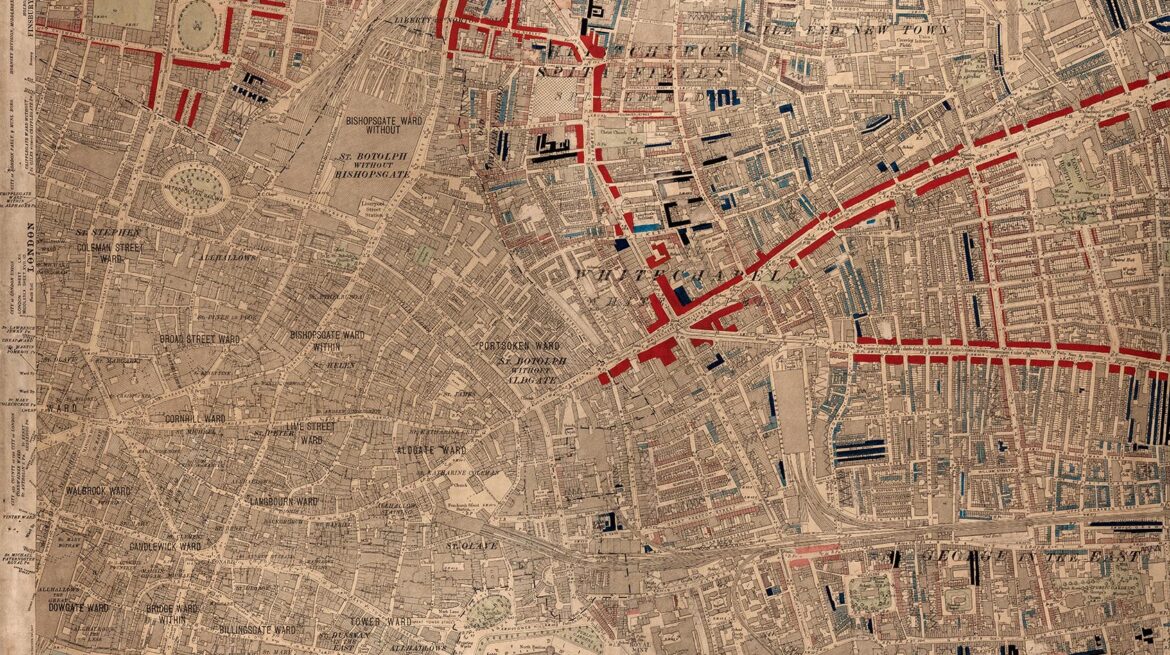
A workshop reimagining the Charles Booth London poverty maps with contemporary lived experience insights and entries from local young people.
Unlike the original Charles Booth London poverty maps, which were produced largely by social researchers in the late 19th and early 20th Century, this project is grounded in co-production and community expertise and brings mapping of the E1 and E2 area into the 21st Century. However, this activity does not replicate the Booth maps by auditing socio-economic, work status, education and other measurable features relating to each street in the area but instead breathes life into the mapping process by working together with residents in creating a ‘living map’ that charts social commentary, identification of meaningful places, lived experiences and particular memories of place.
Working closely with young peer researchers at Toynbee Hall, the project seeks to create a map that reflects lived experience, memory, and meaning according to the lives lived in the E1-3 area. Through stories, visual materials, and place-based insights, the map will articulate what this part of the city represents to those who live, move, and seek support within it.
This interactive workshop, delivered by the young peer researchers and project lead will present some initial mapping already completed from this ongoing four-year project and will offer an opportunity for local residents to contribute their entries.
This event is part of Backyard Biennial.
The project is led by Professor Paula Reavey on behalf of the Leverhulme funded Centre for the Sciences of Place and Memory at the University of Stirling. Anchored in Philosophy and housed in the Faculty of Arts and Humanities, the Centre draws on cognitive sciences, social sciences, and the arts to break new ground in the study of spatial thinking, disorientation, and remembering. It connects the sciences of space and memory with contemporary practical concerns about memory, cognition, emotion, and place. placememory.net