Free entry
Thu 22 Oct 2026, 6.30 - 8.30pm
Assembly Room
| Monday | Closed |
| Tuesday | 11am–6pm |
| Wednesday | 11am–6pm |
| Thursday | 11am–9pm |
| Friday | 11am–6pm |
| Saturday | 11am–6pm |
| Sunday | 11am–6pm |
Access requirements
Whitechapel Gallery is committed to making all of our events as accessible as possible for every audience member. Please contact access@whitechapelgallery.org if you would like to discuss a particular request and we will gladly discuss with you the best way to accommodate it.
Information about access on site at the gallery is available here https://www.whitechapelgallery.org/visit/access/
This includes information about Lift access; Borrowing wheelchairs & seating; Assistance Animals; Parking; Toilets and baby care facilities; Blind & Partially Sighted Visitors; Subtitles and transcripts; British Sign Language (BSL) and hearing induction loops; Deaf Messaging Service (DMS).
Can film and television give us clues about how Black British kitchens of the past looked and felt like?
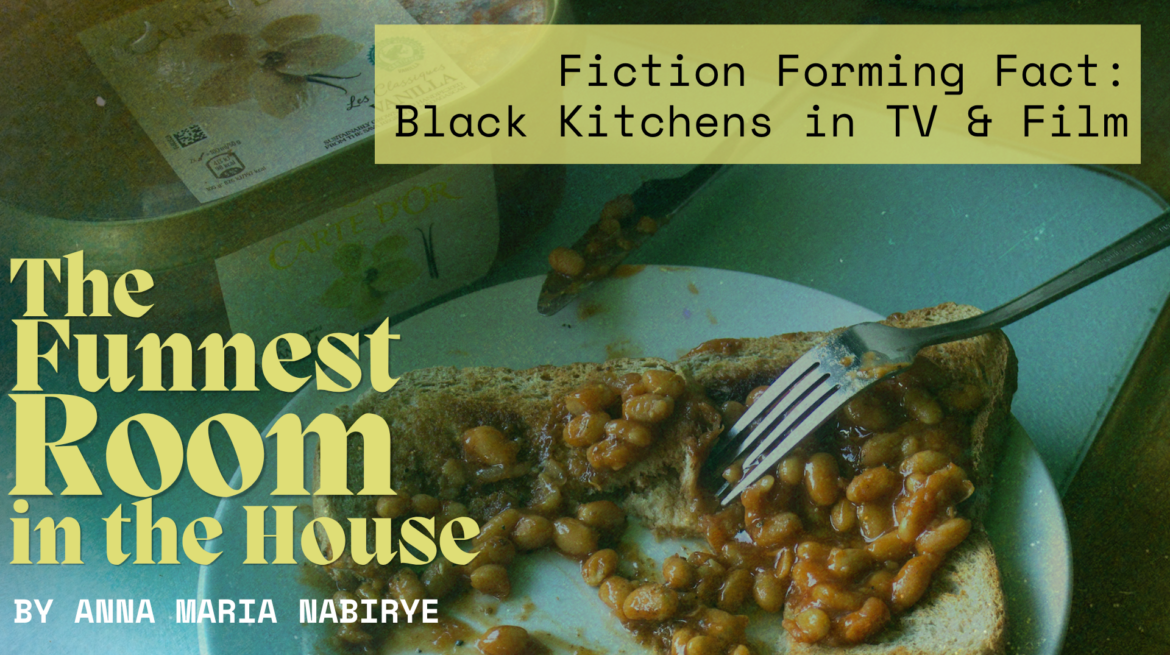
Join artist Anna Maria Nabirye and design historian and production designer Sarah Mursal for an intimate evening of film and conversation, as part of Nabirye’s on-going immersive project, The Funnest Room in the House.
Drawing on the rich history of Black British cinema and television, the evening explores how everyday memories of our kitchens form a vibrant – and often undocumented – archive of the Black British life.
Through a curated selection of iconic and rediscovered screen clips, Anna Maria Nabiyre invites audiences to reflect, remember and connect – exploring how TV and film can reveal or hide truths about Black British life. Do these clips help activate our own memories or do they replace them as the only images left for our consumption?
The evening will be a relaxed cinematic event with film, TV, food, conversation, debate and laughter.
The Funnest Room In the House explores the joy, stories, and deep-seated memories held within the Black British kitchen space. Centred around an installation inspired by Nabirye’s memories of her childhood kitchen, The Funnest Room in the House acts as a portal to the multitude of places we call ‘home’ throughout our lives. Through a combination of installation, photography, audio works, participatory events and workshops, Nabirye playfully examines how the kitchen serves as bridges between daily life in the UK and the back-home of ancestral homelands. The project shines a light on the shape-shifting versatility of the kitchen – celebrating it not just as a room to cook and eat, but as a sanctuary to gather, hide, bathe, and dance in.
Inviting reflection, remembrance, and connection, Nabirye illuminates rich cultural histories and lived experiences that are too often left out of traditional archives.
Supported by commissions from Cement Fields and Jerwood Arts and with funding from Arts Council England & East Sussex Arts Partnership. Produced by Nicky Childs & Lehni Lamide Davies. Developed in Partnership with Whitechapel Gallery, Towner Eastbourne & SAWN Oldham.
Anna Maria Nabirye is a multi-disciplinary artist and performer initiating projects and collaborating across visual arts, performance, fiction, documentary, theatre, screen, social practice and fashion.
Recent work include multimedia visual arts work Up In Arms – centring conversations on the complexities of interracial female friendship, co-created with Annie Saunders, this social practice work formed, an exhibition, 3 channel film and performance, commissioned by the De La Warr Pavilion and produced by Artsadmin (2023).
Other works include The Funnest Room In The House Afterword (Whitstable Biennale 2022), Last Time I saw Snow (Typeone, London Film Festival 2021) Gelato Balleto (Georgina Starr & Hermès 2022) solo adaptation of Medea (The Faction Wilton’s Music Hall).
Nabirye has an on-going collaboration with Noor Afshan Mirza and Brad Butler Ruptures (London Film Fest/Home/Delfina Foundation), Everything For Everyone And Nothing For Us (Mirror City-Hayward), Hold Your Ground (FVU) & Deep State (FVU).
Her own projects include Motherhoody & One Prick At A Time with Jess Mabel Jones (The Albany/King’s College).
Nabirye co-founded and runs Afri-Co-Lab, a creative community dreaming space in St Leonards, East Sussex, they have worked with and created projects for: The Black Cultural Archives, DLWP, Home Live Art, The Royal Court, V&A, SBC, Brighton Museum and Yinka Shonibare’s Guest Projects.
Anna Maria’s acting credits include the National Theatre, Shakespeare’s Globe, The Almeida, Film4, BBC1 and BBC2. As an educator and director Nabirye has worked with Yale School of Drama, National Theatre Institute, Mountview Academy, LAMDA and London Philharmonic Orchestra’s Junior Artists.
Without Joy There Can Be No Liberation.
Sarah Mursal is a Production Designer, Design Historian, Lecturer, and Artist working across television, film, and commercials. Her recent credits include The Power of Parker Series 2, Peacock Series 2, and the latest Mitchell and Webb comedy series. Working primarily across comedy and television drama, she brings a research-led and character-focused approach to visual storytelling.
Sarah’s design philosophy centres on colour, tone, and semiotics as storytelling tools. Through spatial detail and visual language, she explores character psychology, social context, and emotional shifts, ensuring that design actively supports narrative rather than simply decorating it. Care is central to her process of care for story, collaboration, performance, and the working environment allowing her to create emotionally grounded and authentic worlds.
A graduate of Wimbledon School of Art in 1999, Sarah has built an international career working in New Zealand, Australia, Qatar, Saudi Arabia, Portugal, and Spain. Having progressed through the full range of art department roles, she combines creative vision with strong practical and production knowledge. She also completed a Masters in the History of Design through Royal College of Art and the Victoria and Albert Museum, deepening her research into visual culture, representation, and design history.
Alongside her screen work, Sarah is a Film Lecturer at Ravensbourne University London, where she is committed to improving diversity within the art department and wider creative industries. She advocates for cultural representation to be shaped by creatives with lived experience and authentic connections to the heritage being portrayed.
Her wider research and artistic practice explores visual culture, spatial narratives, and the absence of Black British women within design history and media representation. Through oral histories, photography, and community engagement, Sarah works to uncover and preserve underrepresented stories, translating lived experience into visual language. This research-led approach informed her work on Queenie, where authenticity and representation were central to the design process.