Past Event
Whitechapel Gallery is committed to making all of our exhibitions as accessible as possible for every visitor. Please contact access@whitechapelgallery.org if you would like to discuss a particular request and we will gladly discuss with you the best way to accommodate it.
For complete access information about the gallery, please visit here.
About This Event
The film Gaali Kothon — A Tale of Swear Words contains strong language throughout and explicit references to domestic violence, emotional abuse, rape and sexual assault.
This event is free of charge and drop-in, please RSVP using the link on the page to secure your place.
Join Four Corners, London Community Video Archive and Oitij-Jo Collective for an afternoon of screenings and discussion.
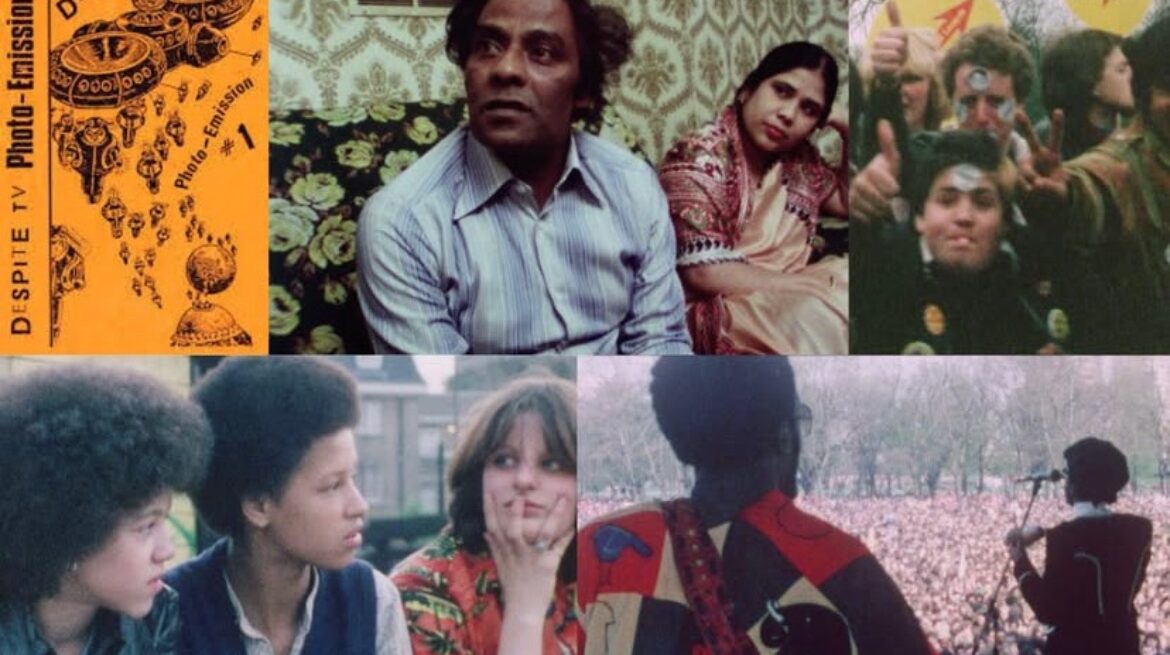
Engaging with community, activism and identity from the 1970s to the present, these short films draw on archive material including a community video magazine, a documentary on Bengali families’ housing struggles, and a film about young people’s attitudes to racism, alongside shorts by contemporary Bangladeshi creators.
Programme
12 noon
Doors open, refreshments
12.15 – 12.45 pm
Round table with Four Corners, London Community Video Archive and Oitij-Jo Collective
12.45 – 1.45 pm
Despite TV video magazine, issue one (Despite TV/Spectacle 1984, 42 mins)
From 1984, Despite TV video magazine was produced by and about residents in East London through weekly workshops covering local news, music, poetry, skits and experimental short films. It was organised by Mark Saunders who later formed Spectacle Films.
Screening followed by discussion.
1.45 – 2.15 pm
Refreshments
2.15 – 3.45 pm
A Safe Place to Be (Director Simon Heaven, 1980, 30 mins)
An exploration of the housing discrimination faced by the Spitalfields Bengali community in the 1980s, this documentary looks at how people were struggling for better lives. Unusually, it features Bengali voices, even if they are all male. Made by local director Simon Heaven, it was shown on Channel 4 in 1981.
Divide and Rule – Never! (Newsreel Collective, 1978, 41 mins)
Young working-class Londoners – first and second generation Black and Asian immigrants, as well as ex-National Front members – discuss their experiences of racism in 1970s Britain, and fight back with rock and reggae.
Screenings followed by discussion.
3.45 – 4.00 pm
Refreshments
4.00 – 4.45 pm
Gaali Kothon — A Tale of Swear Words (Mahamuda Aktar (Monisha), 2024, 16.06 mins)
This short docu-fiction investigates the prevalence of sexist and misogynistic swear words existing in Bangladeshi society and culture, but also universally recognised. Mahamuda Aktar Monisha is a feminist, queer activist and filmmaker from Dhaka, Bangladesh, currently based in Dublin. She is dedicated towards dismantling deep-rooted social injustices through the use of arts and activism, and using storytelling to challenge social norms.
Screening followed by discussion.
4.45 – 5 pm
Final discussion and refreshments.
This event is part of Backyard Biennial.
Four Corners believes in film and photography for all. As a registered charity, our work builds upon almost 50 years of radical, socially-engaged approaches to photography and film.
www.fourcornersfilm.co.uk
@fourcornerse2
The London Community Video Archive (LCVA) collects, preserves and shares community videos made between 1969 and 1994 in London and the South East. From 1984, Despite TV video magazine was produced by and about residents in East London through weekly workshops covering local news, music, poetry, skits and experimental short films. It was organised by Mark Saunders who later formed Spectacle Films. Screening followed by discussion.
the-lcva.co.uk
@the_lcva
OITIJ-JO Collective is dedicated to celebrating Bengali arts and crafts while fostering a sense of community, collaboration, and engagement. Operating out of Tower Hamlets, the organisation focuses on supporting underemployed women, particularly from the British Bangladeshi community, by providing valuable training and creative opportunities.
oitij-jo.org
@oitij_jo
In 1982 the video co-op Despite TV was established by Mark Saunders as part of Tower Hamlets Arts Project in Whitechapel, east London. Taking advantage of new colour video cameras and what became the dominant VHS (Video Home System) technology, Despite TV produced and distributed one half-hour colour DIY ‘TV’ project roughly every two months between 1992 and 1993. The videos, made by, for and about the local neighbourhood, covered such themes as changes to health and social services, local education initiatives, housing struggles, gentrification and unemployment.
Each edition adopted a magazine approach, allowing for a multiplicity of voices and stories to be shared. Instead of having a host connecting each segment, they were butted up against one another, evoking the experience of ‘channel-hopping’. The first edition opens with a segment on local cuts to health services and went on to include an item on the Greater London Council and another made by a local youth group, followed by live footage of a local band, the Mint Juleps.
Unlike some other activist video projects, which tended to have a core team overseeing every aspect of the production, Saunders was keen to avoid having the video resources tightly controlled by a few salaried individuals. Instead, to maximise individual input, he collectivised the equipment, allowing anyone to author their own contribution to the magazine.