Past Exhibition
OITIJ-JO Collective – a Bengali arts and heritage organisation based in East London – present TUFAN.
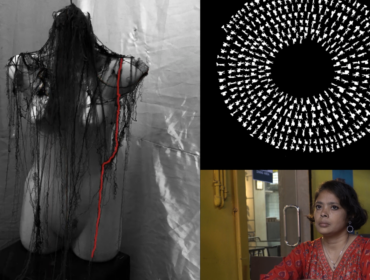
Drawing inspiration from the Bangla word for storm, the exhibition and live programme symbolise sudden change, powerful energy, disruption, and the possibility of renewal. Inspired by Begum Rokeya – pioneering author of the feminist sci-fi short story Sultana’s Dream (1905) – OITIJ-JO Collective explore TUFAN as a process: a movement from turbulence to transformation, from rupture to regeneration.
Extending from Gallery 5 into the Foyle Reading Room, guided by the principle of incremental growth, the group exhibition shifts over time, through additions, artist-led activations, and responses, reflecting how change often happens gradually in the aftermath of upheaval. The exhibition is not a fixed display, but a living thread woven through the entire programme.
Honouring the 121-year legacy of Rokeya’s vision of defiance and imagination, TUFAN invites visitors to relate to the storm in a multitude of ways and collectively imagine what comes next after a moment of rupture.
Participating artists include Rukia Begum, Puer Deorum, Laisul Hoque, Jannat Hussain, Shumaiya Khan, Rezia Wahid MBE, and Anisah Yaminah.
Throughout the summer, TUFAN unfurls itself beyond the exhibition and across the building, through artist-led activations; a collaboration with local Bangladeshi women’s group Mohila Ongon; Stitching Light আলো দিয়ে গাঁথা installation in the foyer, in collaboration with Emergency Exit Arts and artist Ruhul Abdin; The Process of Being Womxn film programme in the Zilkha Auditorium, in collaboration with Paraa, Bangladesh; and musical collaboration with Grand Union Orchestra, Bengal to Bethnal Green, on Sat 15 Aug at Toynbee Studios.
This exhibition is part of Backyard Biennial.
Sat 25 Jul, 2.30 – 4.30pm | Workshop
Weaving a mini tapestry with Rukia Begum
Sun 2 Aug, 2.30 – 3.30pm & 3.30 – 4.30pm | Workshop
Mark a milestone with Rezia Wahid MBE
Sat 15 Aug, 2.30 – 4.30pm | Drop-in workshop
Make a yarn winding artwork with Anisah Yaminah
Sat 22 Aug, 12 – 1.30pm | Drop-in participatory performance
A Bead for Remembering with Jannat Hussain
Thu 27 Aug, 7 – 7.30pm | Performance
Foyle Reading Room | Drop-in | 11am-6pm
The OITIJ-JO Collective Community Library is rooted in a belief that South Asian – particularly Bangla, Bangladesh, and West Bengal origin – stories, scholarship, and creative voices deserve permanent and accessible presence in public cultural life; not as footnotes but as foundations.
Built entirely from community donations, the library embodies the principle of collective ownership – every book represents an act of generosity and an assertion that this knowledge matters.
Housed within the Foyle Reading Room in dialogue with a curated selection of Whitechapel Gallery’s own Archive collection, the OITIJ-JO Collective Community Library affirms the cultural value of community-held ways of knowing and sharing.
For visitors, it offers an invitation to read, reflect, and connect. For the community, it is recognition and acknowledgement of their stories, in a space that honours them.
Foyer | 11am-6pm
Stitching Light আলো দিয়ে গাঁথা is a textile and light installation exploring Bangladeshi women’s migration to the UK.
Stories have been collected from groups of Bangladeshi women living in Tower Hamlets, Leeds, Bradford, Middlesbrough, Worcester, and Salford who have lived experience of this migration journey.
Their stories have been gathered and transcribed onto 3m high colourful painted textile panels, hand-painted by a traditional folk artist based in Dhaka and hand-stitched with light reactive thread to highlight the journeys they have taken.
This iteration of the installation in the foyer features a curated selection of the banners which OITIJ-JO Collective worked on with local women in Tower Hamlets.
This project was conceived by Emergency Exit Arts, in partnership with OITIJ-JO Collective, The Migration Museum, and Bangladesh-based Paraa, with Ruhul Abdin as Creative Director, and supported by National Lottery Heritage Funding.
OITIJ-JO Collective is dedicated to celebrating Bengali arts and crafts while fostering a sense of community, collaboration, and engagement. Operating out of Tower Hamlets, the organisation focuses on supporting underemployed women, particularly from the British Bangladeshi community, by providing valuable training and creative opportunities.
OITIJ-JO’s Key areas of work are:
OITIJ-JO Arts & Crafts
OITIJ-JO Kitchen
OITIJ-JO Design Studios
Strategic Engagement
‘YOU CANNOT BE WHAT YOU CANNOT SEE’ Marian Wright Edelman.
OITIJ-JO was established to enable the British Bangladeshi diaspora to shape their own narrative within UK’s highly lucrative and influential creative sector. A key focus of the organisation is to prioritise the inclusion of British Bangladeshi, South Asian, and global majority creative practitioners in its projects and initiatives.
OITIJ-JO Art Space, Poplar, activated in early June will be showcasing additional roster of short films from Bangladesh and host artists and DJs throughout the summer. Join us.
Rukia Begum is a British-Bangladeshi fashion and textile designer whose work blends bold surface design with cultural narrative. A graduate of the University of the Arts London, she specialises in print, pattern, and material exploration, creating pieces that reflect identity, heritage, and memory.
Her collections have been showcased on Not Just A Label, the global platform for emerging fashion talent, where her silk-printed garments and textile works express a strong visual language rooted in colour, texture, and storytelling. Inspired by journeys between London and Bangladesh, her practice often explores themes of migration, femininity, landscape, and belonging.
Alongside her design practice, Begum is an experienced educator and creative leader. She currently leads an Art & Design department in East London, where she shapes curriculum, mentors emerging creatives, and champions textile design as both craft and contemporary art. Her leadership allows her to bridge industry practice with education, nurturing the next generation of designers while continuing to evolve her own artistic voice.
Working across fashion, weaving, and textile art, Begum’s work is tactile, expressive, and deeply personal — grounded in craftsmanship and driven by narrative.
Puer Deorum balances negotiations between weight and ephemerality, and the scope of mortality. Referencing psycho/socio political geographies, they question ideas around the experience of time. Teasing temporalities through endurance and duration, amplifying (inter)personal experiences through dream sequences, interpretive actions, and incantations of love.
As an interdisciplinary artist, their work stems from a foundation of thinking through the body, moving between disciplines. They draw from emotional landscapes and respond to site through documenting the covert in the everyday and layering memories to create cartographies, serving as undercurrents to the imagining of alternative futures, parallel worlds and co-existing timelines.
Selected sharings of their art include: Whitechapel Gallery (UK), Serendipity Arts Festival (IN), Les Urbaines (CH). They were a finalist for the WoCAA, receiving the Rita Keegan Foundation travel award (2026) and were awarded Arts Council DYCP grant (2023). They curated ELO MELO festival (2023), in East London at Whitechapel Gallery and Toynbee Hall with Oitij-jo Collective. Talks in the UK include Serpentine Gallery, Tate Modern, and Glastonbury Festival. They are a participant in La Becque’s Principal Residency Programme (CH, 2026).
Laisul Hoque is a London-based artist, born in Dhaka, Bangladesh, working across installation and film. His practice explores autobiographical histories and their intersections with broader political, cultural, and emotional landscapes, often realised through sculpture, installation, and forms of expanded storytelling.
He was a finalist for the CIRCA Prize 2024 and is the winner of the East London Art Prize 2025.
After studying literature in Dhaka, Hoque completed an MA in Contemporary Photography: Practices and Philosophy at Central Saint Martins, University of the Arts London. His work has been presented at the Whitechapel Gallery, Barbican Centre, Experimenta India, and Alliance Française de Dhaka.
Jannat Hussain is an interdisciplinary artist and creative facilitator. Her practice orientates the space between introspective realities and outward expression, where close observation of the self and interpersonal dynamics translates into highly emotive responses.
Her work is experiential, operating on the erudition of feeling. It consists of extrapolating sentimental moments in her life that are worthy of rendering, to map her emotional landscape. Jannat’s current concerns lie in using the material and cultural attributes of sculpture and performance art to unpack various forms of intimacy, tracing how vulnerability and connection manifest within personal and collective experiences.
The tactile qualities of clay and the transformative effects of nature on land currently serve as anchoring points in her practice, emphasising the role of memory in honouring relationships when investigating the broader dimensions of intimacy.
She is currently the Creative Programme Coordinator for Arts Network, an arts and mental health charity. Selected exhibitions include Tate Britain, The V&A, The Albany Theatre, Cooke Latham Gallery & FILET.
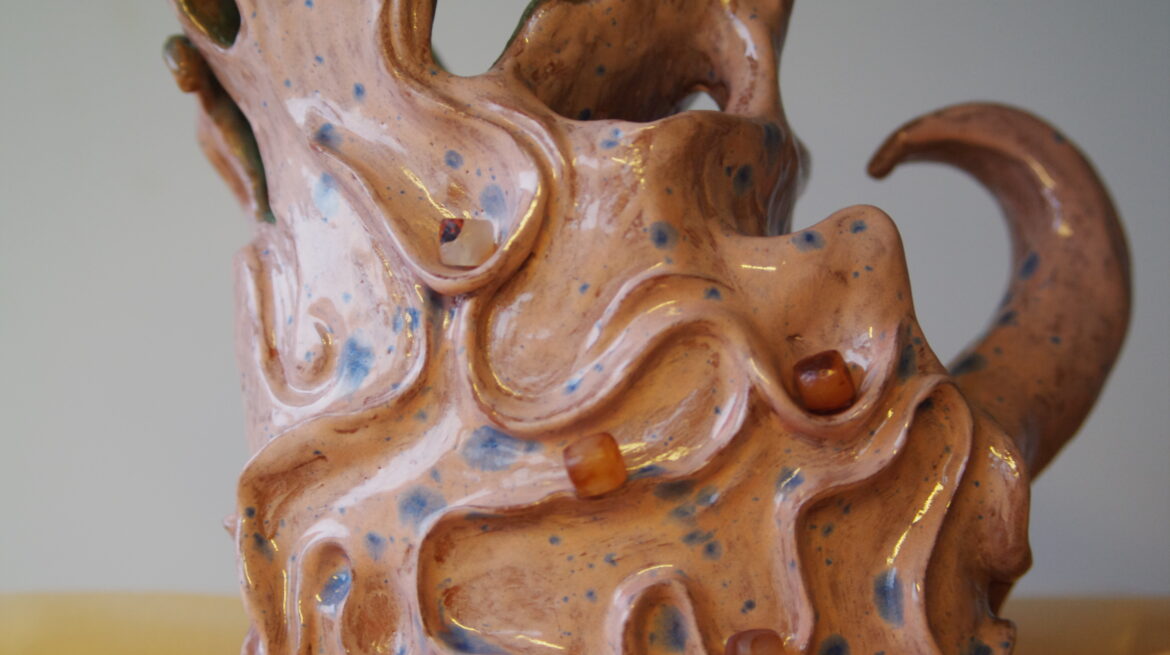
Shumaiya Khan’s practice is informed by reoccurring instinctual forms received via symbiotic and somatic release. Often referencing a mirroring between the metaphysical and physical human bodies, as well as concealed landscapes such as the inner depths of forests, caves, flesh, veins and quarries. Pieces often embody hidden elemental surfaces or entities, often bodily shaped and height. Forms and environment which appear grow, erode or age. She builds out these internal worlds to interact with our external realms. Works produced with oil, salt, ceramic, and textile. Her practice is both research and physical, hands-on process.
Paintings and sculptures emerge through repeated layering, washing away, rebuilding oil paint mixed with salt; creating visceral, full-bodied, and textured surfaces. The resulting works are installed as immersive environments, combining stretched and folded paintings, suspended with ribbons or supported by treated wood structures, alongside ceramic sculptures.
Explorations within feminine origin ancient mythologies, mysticism and animism, consider her past self’s journey within spiritual realms, affecting her everyday position on the current socio-political landscape the feminine she finds herself in. Personal release of facades inherited from industrialised patriarchal worlds, content on upholding external accolades over the human care and condition.
Rezia Wahid MBE is a British Bangladeshi textile artist and doctoral researcher whose work explores intersection of weaving with delicate fine natural yarns which seek to evoke light and air, performance, and cultural narratives.
Wahid is currently involved with her practice-led PhD research, titled Thread of Fate: Text as Textiles and Performance, where she is investigating the multiple languages of textiles, examining how threads can embody stories, memory, identities, and rituals across cultures. Central to her inquiry is challenging and untangling colonial legacies within the Jamdani textile traditions of Bangladesh. Her work reflects themes of heritage, migration, decolonial thought, and interconnectedness, positioning textiles as a medium of dialogue between materiality and meaning.
Anisah Yaminah is a textile designer, specialising in weave as a medium to visually narrate stories of nostalgic feelings, memories and childhood moments. Family albums, objects and clothes are archival pieces of work that are important to her research as they are ways to translate stories in woven textiles. Blending her Bangladeshi heritage and London roots together plays a significant part in her creative practice as they inform her narrative as well as colour, patterns and materials. Growing up in London, surrounded by different cultures has led her to interweave themes of identity, land and home which is reflective in the primary research she gathers. This personal approach to her work lets others see how she uses weave as a tool to explore her identity.
Backyard Biennial has been generously supported by:
Aldgate Connect BID