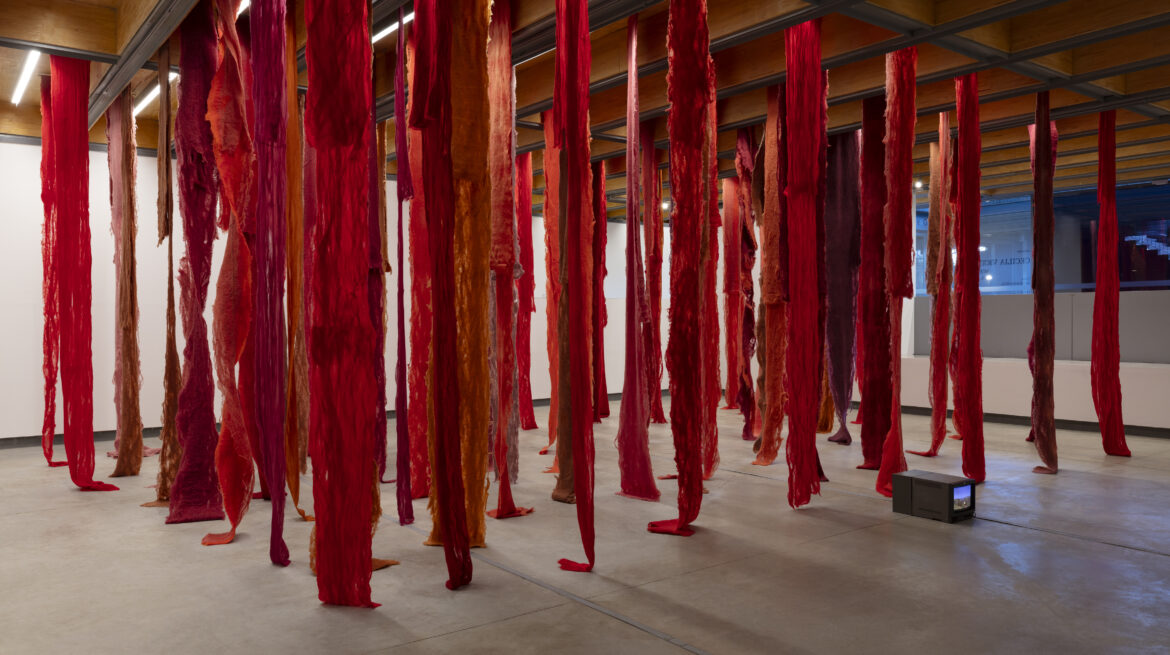
Cecilia Vicuña, Quipu Menstrual 1 (unknotted), 2006 / 2024. Site-specific installation with unspun wool and video. Dimensions variable; video duration: 4 minutes, 13 seconds. Installation view, Cecilia Vicuña: Soñar el Agua. Pinacoteca do Estado de São Paulo, Brazil. May 17 – September 15, 2024. Photo Isabella Matheus
07 Oct - 14 Feb 2027
Galleries 1, 2 & 3
| Monday | Closed |
| Tuesday | 11am–6pm |
| Wednesday | 11am–6pm |
| Thursday | 11am–9pm |
| Friday | 11am–6pm |
| Saturday | 11am–6pm |
| Sunday | 11am–6pm |
Whitechapel Gallery is committed to making all of our events as accessible as possible for every audience member. Please contact infodesk@whitechapelgallery.org if you would like to discuss a particular request and we will gladly discuss with you the best way to accommodate it.
Information about access on site at the gallery is available here: https://www.whitechapelgallery.org/visit/access/
This includes information about Lift access; Borrowing wheelchairs & seating; Assistance Animals; Parking; Toilets and baby care facilities; Blind & Partially Sighted Visitors; Subtitles and transcripts; British Sign Language (BSL) and hearing induction loops; Deaf Messaging Service (DMS).
This extensive exhibition marks the first major UK exhibition of Cecilia Vicuña (b.1948, Santiago, Chile) – one of Latin America’s most internationally renowned artists, poets, and feminist activists. Spanning six decades, the presentation provides a unique opportunity to explore Vicuña’s interdisciplinary practice, which intentionally dissolves the boundaries between visual art, poetry, performance, ritual and activism, and encompasses works across painting, textile, photography, installation and film.
Born and raised in Santiago, Vicuña came to London to study at Slade School of Art in the early 1970s, and self-exiled after the violent military coup against President Salvador Allende in 1973. As a creative and personal response to the situation in Chile, Vicuña’s practice became more explicitly political during the Allende period (1970-73), a process that intensified in London reflecting her experience of displacement, loss, political violence and instability. The exhibition includes a dedicated display on Artists for Democracy (AFD), the organisation Vicuña co-founded in London in 1974 with David Medalla, John Dugger and Guy Brett in solidarity with Chile and other liberation struggles worldwide, and brings together never-before-seen documents, photographs and printed materials.
Another key facet of Vicuña’s work, evident from the 1960s onwards, is her deep commitment to honouring and preserving ecosystems and indigenous systems of knowledge. Many of her installations function as acts of remembrance for cultures, languages and ways of being that have been suppressed by dominant Western models and colonial systems. The exhibition brings together key emblematic works from across her career including the spectacular Quipu Menstrual (2006–2024), a dense sculptural installation of unspun wool in vivid shades of red and brown suspended from the ceiling. Vicuña has been creating quipus (knots) for over 50 years as striking embodiments of an ancestral, non-alphabetic communication system rooted in Andean culture. Also on display will be the only surviving work from her precarios series she made during her time in London, as well as documentation of the 400 lost works from that same collection. Vicuña began making precarious in the mid-1960s. There small sculptures, crafted from papers, prints, fabric, feathers and other found materials are defined by their ephemerality and challenge conventional understandings of sculpture as fixed or permanent.
The presentation features a selection of paintings from Vicuña’s time in London in the 1970s, as well as work from her acclaimed Palabrarmas series, which she began during her time in London, and a series of works dedicated to Vicuña’s performances and interventions in public spaces.
For full details of the exhibition and works on display please see/download the press release.
Cecilia Vicuña: Living Threads has been principally and generously supported by The Colwinston Charitable Trust.
The exhibition is a partnership between IMMA, Dublin and Whitechapel Gallery, London.
Principal supporter:

The Colwinston Charitable Trust 30th Anniversary Fund
With support from: Embassy of Chile in the UK
Cecilia Vicuña Exhibition Circle and Patrons: Xavier Hufkens, Lehmann Maupin, New York, Seoul, London, Soliman Travel. Jane Soliman, Juliana Fortunato Wates, Zarela Feeney, Mareida Restaurant